
Washington County Criminal Court Cases
Washington County Superior Court handles felony prosecutions and keeps the formal file through the Clerk of Court. State Court handles county misdemeanors and traffic matters within its jurisdiction. Magistrate Court deals with arrest and search warrants, first appearances, commitment hearings, and other early criminal steps. A city citation may stay in Sandersville, Tennille, or Davisboro Municipal Court, so the issuing agency and citation heading matter.
The docket becomes the best map of a filed case. It identifies the court, case number, parties, charging document, hearing entries, motions, and disposition. A sheriff booking charge is only an intake description and can change after review by a prosecutor. For that reason, use the Washington County court file when the question concerns what was formally charged or how the case ended.
Washington Court Files on Haynes Street
The clerk's criminal-record counter is at 132 West Haynes Street, Sandersville, Georgia 31082. The published office hours are Monday through Friday, 9 a.m. to 5 p.m., and the main number is 478-552-3186. Ask for the docket first. It can show which entries or final orders are worth copying and prevents paying for pages that do not answer the question.
Washington County Clerk of Court
132 West Haynes Street
Sandersville, GA 31082
478-552-3186
Monday-Friday, 9 a.m.-5 p.m.
Ordinary Superior Court copies cost $1 per page. Certification costs $2.50 for the first page and $0.50 for each added page. Those are court-copy charges, not fees for a sheriff report, municipal ticket, or GCIC history.
| Item | Published amount |
|---|---|
| Ordinary Superior Court copy | $1 per page |
| Certified first page | $2.50 |
| Each added certified page | $0.50 |
Searching Washington County Case Records
No verified free countywide name-search box covers every Washington County criminal file. Use the local clerk as the complete fallback. Georgia Courts e-Access routes users to account-based court access, but coverage, cost, and document availability can differ by court. An absent result does not establish that no file exists.
- Identify the issuing court from the citation, warrant paperwork, booking entry, or notice.
- Try Georgia e-Access if that court participates and remote access suits the request.
- Search with the case number when known; otherwise use the full name and an approximate filing year.
- Call or visit the clerk when the record is old, missing, or not available online.
- Request the docket, then order the specific judgment, sentence, or certified disposition needed.
| Field Label | Type | Required | Notes |
|---|---|---|---|
| Party name | Text | Search dependent | Use the full legal name and check spelling variants. |
| Case number | Text | No | The most precise identifier when available. |
| Filing year | Date/year | No | Helps separate people with similar names. |
| Court or case type | Select | Search dependent | Choose the criminal division that owns the file. |
The official Georgia e-Access page shows the state routing interface used for account-based court access.
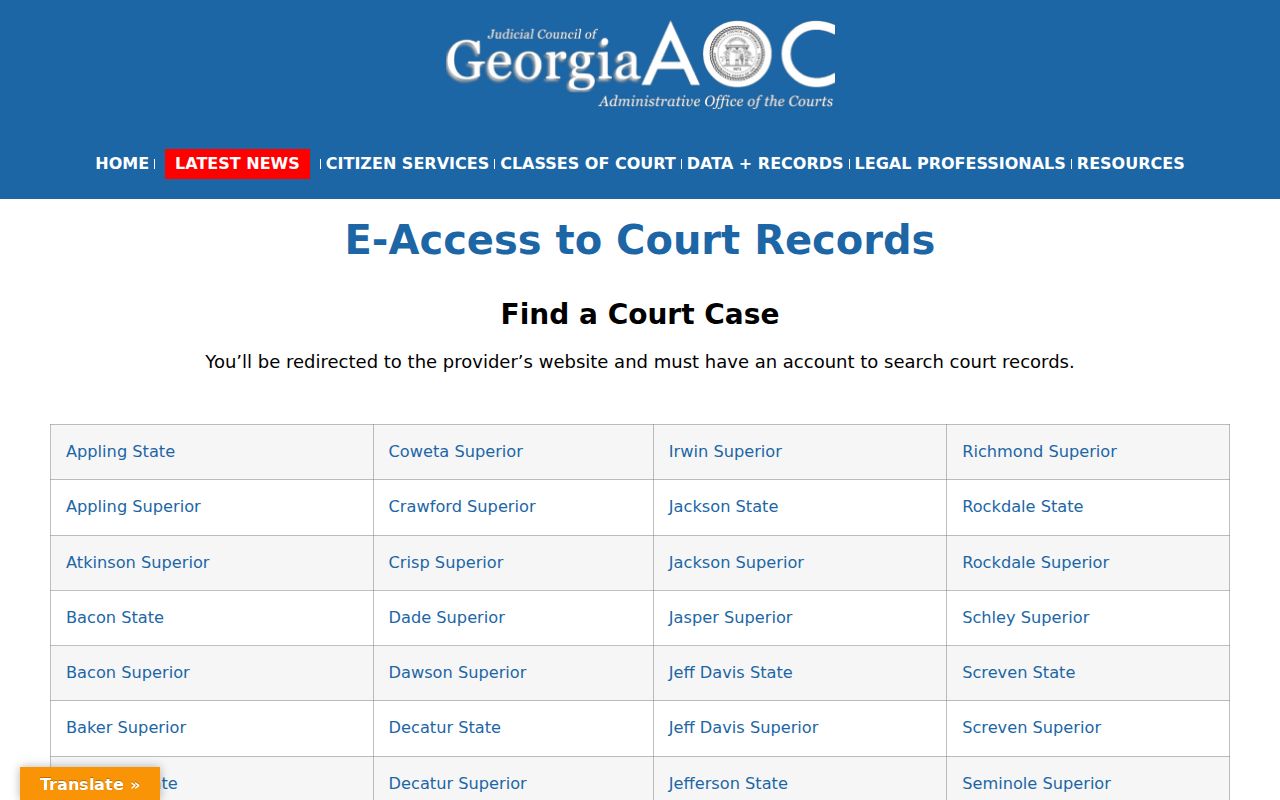
Its presence does not replace a clerk request where a Washington County file or image is unavailable.
Felony and Misdemeanor Court Paths
Felonies proceed in Superior Court, while State Court handles misdemeanors within its authority. Magistrate Court sits earlier in the path. It issues warrants, conducts first appearances, and holds commitment hearings that test whether probable cause supports moving a felony matter forward. Washington County publishes Monday and Wednesday criminal-calendar blocks and a 4 p.m. first-appearance practice at the jail.
Municipal court is different. A city traffic or ordinance case can remain in the city docket. Tennille's GovernmentWindow route accepts ticket payments, but payment controls are not a historical case search. Contact the named municipal clerk for status, then use the Washington County clerk only if the prosecution moved to county court.
The official Sandersville site provides civic context for the county-seat court hub.

That city channel should not be confused with the county court docket.
Inside a Washington County Case File
A filed case tells a different story from an arrest entry. Read the charging paper and the last disposition together. An accusation is a prosecutor-filed charge commonly used for eligible cases. An indictment is a grand-jury charging document. A no bill means the grand jury declined to indict. Nolle prosequi means the prosecutor chose not to proceed on that charge at that time.
| Case number and court | Identifies the exact Washington County file and division. |
|---|---|
| Charging document | Shows charges filed by accusation or indictment, which may differ from booking labels. |
| Docket entries | Chronological record of filings, hearings, motions, and orders. |
| Hearing dates | Lists scheduled events and may note continuances or completed hearings. |
| Disposition and judgment | States the outcome for each count, such as plea, trial result, dismissal, or nolle prosequi. |
| Sentence and conditions | Records punishment and court-ordered terms when a conviction occurs. |
Read Washington County Disposition Terms
A case status alone can mislead. “Pending” usually means no final disposition has posted. “Dismissed” must be matched to the correct count because another charge in the same file may have a different outcome. “No bill” and “nolle prosequi” are not convictions. Neither term means the court file automatically vanishes.
- Arraignment
- The hearing where charges are stated and a plea is entered.
- Disposition
- The recorded outcome of a charge.
- Nolle prosequi
- A prosecutor's formal decision not to continue a charge at that time.
- No bill
- A grand jury's decision not to return an indictment.
When a GCIC record lacks the final result, request a certified disposition from the clerk and follow the Georgia Crime Information Center challenge process. The court certifies what happened in its file; GCIC maintains the repository record.
How a Criminal Case Moves
A case may begin with a warrant or a warrantless arrest. The jail handles booking, and Magistrate Court handles the first appearance. A commitment hearing can address probable cause before a felony matter is referred for prosecution. The district attorney then decides what charges to present or file. Once charges are filed, the clerk opens the formal court case.
Case flow: Charges Filed › Arraignment › Pretrial › Plea or Trial › Disposition › Sentencing
Each stage can create a docket entry, but not every event produces a public document image online. Continuances can move dates, and sealed material will not appear in ordinary public access. Verify the latest status with the clerk instead of treating an old calendar date as proof that a hearing occurred.
Older Washington County Court Records
For an older or offline case, call the clerk with a full name, approximate year, and likely court. A written request is useful when the search spans years or when mailed copies are needed. Georgia's Open Records Act generally requires an agency response within three business days, but that is a response rule, not a promise that all copies will be produced within three days.
The official Tennille homepage illustrates one municipal source that may help route a city citation.

CodeRED alerts shown there concern current public safety and do not serve as a court-record archive.
Give enough detail to locate the file, but request only the needed docket or final order first. Juvenile matters, sealed files, victim data, and protected identifiers can be withheld or redacted under specific law.
Case Record Access and Restrictions
Georgia court records are generally open, subject to court rules, sealing orders, and statutory exemptions. O.C.G.A. § 50-18-71 governs inspection and copying under the Georgia Open Records Act, while § 50-18-72 lists exemptions. Juvenile records, protected victim details, Social Security numbers, and sealed material may be absent or redacted.
Online limits are not the same as legal closure. Ask the clerk whether the case is indexed under another spelling, held offline, in a different court, or restricted by order. Record restriction under O.C.G.A. § 35-3-37 affects eligible criminal-history dissemination, but it does not by itself promise erasure of every court-file reference. Check both GCIC and the clerk when reviewing your own record.
Certified Washington County Dispositions
A certified disposition is often the most useful court record when a personal GCIC history lacks an outcome. It identifies the Washington County case, the charge, and the final result, and it carries the clerk's authentication. Ask for the disposition rather than every page in the file. The clerk publishes a $2.50 first-page certification charge plus $0.50 for each added page, while ordinary Superior Court copies cost $1 per page.
Before ordering, give the full name used in court, an approximate filing year, and the case number if known. Confirm whether the disposition covers each count. One case can contain several charges with different outcomes. A dismissal on one count does not describe the rest of the file, and a jail release entry does not supply a court result.
Once obtained, compare the certified paper with the repository entry. GCIC maintains the statewide criminal-history record, while the Washington County clerk can correct or certify only its own court file. If the court document is accurate but the repository is not, follow GCIC's inspection and challenge process with the supporting disposition.
Municipal or County Criminal Case
The issuing document points to the right clerk. A Sandersville, Tennille, or Davisboro ticket may stay in municipal court. Tennille's online payment route, for example, accepts payments but does not expose a historical criminal docket. A felony accusation or indictment belongs in Washington County Superior Court, while a county misdemeanor can fall within State Court.
When the court is uncertain, start with the agency shown on the citation or booking entry. Ask whether the case remained municipal, was bound over after a Magistrate Court hearing, or was filed by the district attorney. That short routing call avoids searching the wrong index. It also explains why the same incident may have an agency report number, jail booking number, and court case number.